How to Start a Forex Brokerage: Costs & Prop Alternative
Discover how to start a forex brokerage in 2026. Compare licensing costs, liquidity bridges, and why founders launch a self-hosted prop firm instead.
Every year, thousands of traders and financial entrepreneurs research how to start a forex brokerage, dreaming of running a high-volume dealing desk.
They imagine collecting spreads around the clock, managing institutional liquidity, and building a multi-million-dollar financial brand.
The operational reality in 2026 is vastly more brutal than glossy turnkey brokerage brochures suggest.
Starting a licensed retail brokerage requires hundreds of thousands of dollars in regulatory capital, strict offshore substance laws, and predatory merchant processing fees.

Before wiring life savings to offshore corporate formation agents, founders must understand the true cost breakdown of running a retail brokerage versus modern alternatives.
In this operator guide, we unpack the real line-item capital requirements for launching a forex broker in 2026 and examine why forward-thinking operators launch a self-hosted proprietary trading firm instead.
1. The Anatomy of Starting a Retail Forex Brokerage
A retail forex broker is a regulated financial institution that accepts client deposits, provides margin trading facilities, and routes or clears orders against interbank liquidity.
Unlike simple software companies, brokerages operate under intense regulatory supervision and bear direct fiduciary responsibility for client depositor balances.
To start a brokerage firm, an operator must coordinate four complex operational pillars simultaneously:
- Legal Jurisdiction & Licensing: Securing an offshore or onshore regulatory license with segregated client accounts and capital adequacy buffers.
- Trading Platform & Bridge Infrastructure: Licensing server architecture (such as MetaTrader 5 or cTrader) and bridging order flow to liquidity providers via FIX 4.4 protocol.
- Liquidity & Clearing Facilities: Depositing tens of thousands of dollars in non-interest-bearing margin collateral with a Prime of Prime (PoP) clearing house.
- High-Risk Payment Rail Integration: Contracting high-risk merchant acquirers to process credit cards and local bank transfers without suffering crippling rolling reserves.
Failing at any single pillar stops operations dead in their tracks before your first client deposits a single dollar.
Let us examine each pillar's financial demands in complete transparency.
2. Legal Jurisdictions & Licensing Costs ($50,000 to $300,000+)
You cannot legally accept retail trading deposits without a financial services license.
Attempting to operate an unlicensed brokerage results in immediate bank account freezes, payment processor blacklisting, and criminal regulatory sanctions.
Tier-1 Onshore Jurisdictions (FCA, CySEC, ASIC)
Tier-1 licenses represent the gold standard of trust, but their regulatory thresholds are out of reach for independent entrepreneurs.
Regulators like the UK Financial Conduct Authority (FCA) or Cyprus Securities and Exchange Commission (CySEC) demand minimum regulatory capital reserves of €730,000 to €1,200,000.
Compliance audits, local physical office leases, and resident executive directors push annual operating overhead past $250,000.
Consequently, first-time brokerage founders almost exclusively target offshore regulatory havens.
Tier-3 Offshore Jurisdictions (Seychelles, Mauritius, Vanuatu)
Offshore jurisdictions offer significantly lower statutory capital requirements, yet costs have surged dramatically over recent years.
Due to global FATF anti-money-laundering crackdowns, jurisdictions like Seychelles (FSA), Mauritius (FSC), and Vanuatu (VFSC) now enforce strict economic substance regulations.
| Offshore Jurisdiction | Minimum Statutory Capital | Legal & Application Fees | Local Director & Substance (Annual) | Total Year 1 Regulatory Cost |
|---|---|---|---|---|
| Seychelles (FSA) | $50,000 (must be blocked) | $25,000 to $35,000 | $30,000 to $45,000 | $105,000 to $130,000 |
| Mauritius (FSC) | $25,000 (SEC license) | $30,000 to $40,000 | $35,000 to $50,000 | $90,000 to $115,000 |
| Vanuatu (VFSC) | $45,000 (security deposit) | $20,000 to $30,000 | $25,000 to $40,000 | $90,000 to $115,000 |
| St. Vincent (Unregulated IBC) | $0 (No FX license issued) | $5,000 to $10,000 | $5,000 to $10,000 | Unbankable / Blacklisted |
Many inexperienced founders attempt registering a St. Vincent and the Grenadines (SVG) company because it costs under $10,000.
The SVG Financial Services Authority publicly announced that it does not regulate forex trading, meaning Tier-1 banks and card processors outright refuse SVG corporate accounts.
3. Trading Platforms & Liquidity Bridges ($70,000 to $120,000/yr)
Once your corporate entity exists, you must license trading terminal software and connect it to institutional liquidity feeds.
In retail forex, MetaTrader 5 (MT5) remains the undisputed market benchmark that traders expect.
MetaQuotes White Label Restrictions & Server Costs
MetaQuotes has tightened white label approvals significantly over the past three years.
To qualify for an MT5 White Label, you must present a verified regulatory license, proof of physical office leases, and pass intensive corporate compliance scrutiny.
Setup fees for an MT5 White Label typically start at $10,000 to $15,000 upfront.
Ongoing monthly server maintenance ranges from $5,000 to $8,500 per month, regardless of whether your brokerage has ten clients or ten thousand.
Prime of Prime (PoP) Clearing & FIX 4.4 Engine
Trading software is merely a graphical interface; it cannot execute trades without liquidity providers (such as LMAX, Finalto, or B2Broker).
To inspect enterprise provider pricing structures, review our detailed audit of B2Broker prop firm software costs.
Connecting to a Prime of Prime requires placing a cash clearing collateral deposit of $50,000 to $100,000 directly with the liquidity provider.
Additionally, you must license a specialized FIX 4.4 bridge (such as Gold-i or oneZero) to route orders between MT5 and your clearing house, costing another $2,000 to $4,000 monthly.
Skip the monthly fees
Own your prop firm platform outright. One time purchase.
Full source code. Live in 7 days. No revenue share. No monthly SaaS bill. See the exact platform before paying anything.
Demo login: haris / asdf1122. No signup needed
4. Payment Processing & High-Risk Banking Friction
Payment processing is where most new forex brokerages fail within their first ninety days.
Mainstream payment gateways like Stripe, PayPal, and Adyen explicitly prohibit retail forex trading under their acceptable use policies.
Brokerages must rely on offshore high-risk merchant acquirers and electronic money institutions (EMIs).
These high-risk payment service providers (PSPs) extract massive fees that directly erode operator profitability:
- Exorbitant Merchant Discount Rates (MDR): High-risk processors charge between 5% and 8% per card deposit transaction.
- Punitive 10% Rolling Reserves: Processors hold 10% of your gross client deposit volume in escrow for 180 days to guard against chargebacks.
- Sluggish Settlement Cycles: Payout settlements often take 7 to 14 business days to clear into your corporate operating account.
- Corporate Account Opening Charges: Offshore business bank accounts at crypto-friendly EMIs require $10,000 to $25,000 in upfront onboarding and compliance vetting fees.
If your brokerage generates $100,000 in monthly client deposits, the processor holds $10,000 hostage in rolling reserve for half a year while charging $7,000 in processing fees.
This massive liquidity lockup drains working capital and creates constant cash flow vulnerabilities.
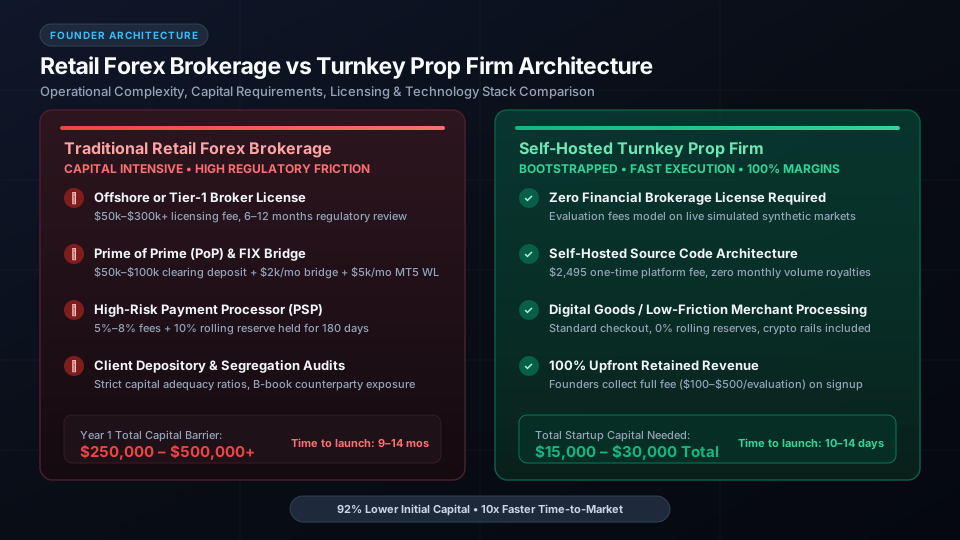
5. The Dealing Desk Trap: A-Book Margins vs B-Book Exposure
Running a brokerage forces you to make a dangerous fundamental choice on trade execution: A-book routing or B-book internalization.
Both operational paths present severe balance sheet hazards for newly capitalized operators.
The A-Book Spread Squeeze
In an A-book model (Straight-Through Processing, or STP), you route 100% of client trades directly to your Prime of Prime liquidity provider.
You bear zero market risk because the clearing house fills the trades, earning only a tiny markup on the spread or a commission per lot.
A-book margins are razor-thin, typically generating just $2 to $5 per standard lot ($100,000 volume) traded.
To cover your fixed $10,000 monthly platform and bridge expenses, your clients must trade over 2,500 lots every month just to reach operational break-even.
The B-Book Counterparty Risk
In a B-book model (Market Maker), you take the opposite side of client trades internally without routing to an external clearing house.
When clients lose, the brokerage profits; however, when profitable clients experience winning streaks, the brokerage must pay out profits from its own treasury cash.
One sharp trader or news-scalping bot catching a 200-pip breakout on Gold can wipe out months of startup reserves in thirty seconds.
Without millions in balance sheet capital to absorb drawdown swings, independent B-book brokerages face imminent insolvency during volatile macro events.
6. Full Year 1 Financial Breakdown: How Much to Start a Forex Broker?
When calculating the realistic forex brokerage startup cost, founders must aggregate regulatory filings, platform licensing, and non-interest-bearing clearing reserves.
Let us itemize each capital vector to reveal the true minimum financial commitment required to launch an offshore retail brokerage in 2026.
| Operational Expense Category | Low-End Offshore Estimate | Industry Standard Setup | Institutional Tier-1 Setup |
|---|---|---|---|
| Corporate Formation & Legal Retainer | $25,000 | $40,000 | $150,000+ |
| Statutory Regulatory Capital (Blocked) | $50,000 | $50,000 | $730,000+ |
| MT5 White Label Setup & Year 1 Server | $70,000 | $90,000 | $140,000 |
| FIX 4.4 Liquidity Bridge ($2k/mo) | $24,000 | $30,000 | $48,000 |
| Prime of Prime Clearing Collateral | $50,000 | $75,000 | $200,000+ |
| High-Risk Bank & EMI Onboarding | $15,000 | $25,000 | $50,000 |
| Payment Processor 10% Rolling Reserve | $20,000 | $40,000 | $100,000+ |
| Minimum Cash Flow Reserve Buffer | $25,000 | $50,000 | $150,000 |
| Total Year 1 Minimum Capital | $279,000 | $400,000 | $1,568,000+ |
Starting a traditional retail forex brokerage demands a realistic capital commitment of $280,000 to $400,000 before onboarding a single active trader.
For independent founders without institutional venture funding, this capital barrier is often an insurmountable hurdle.
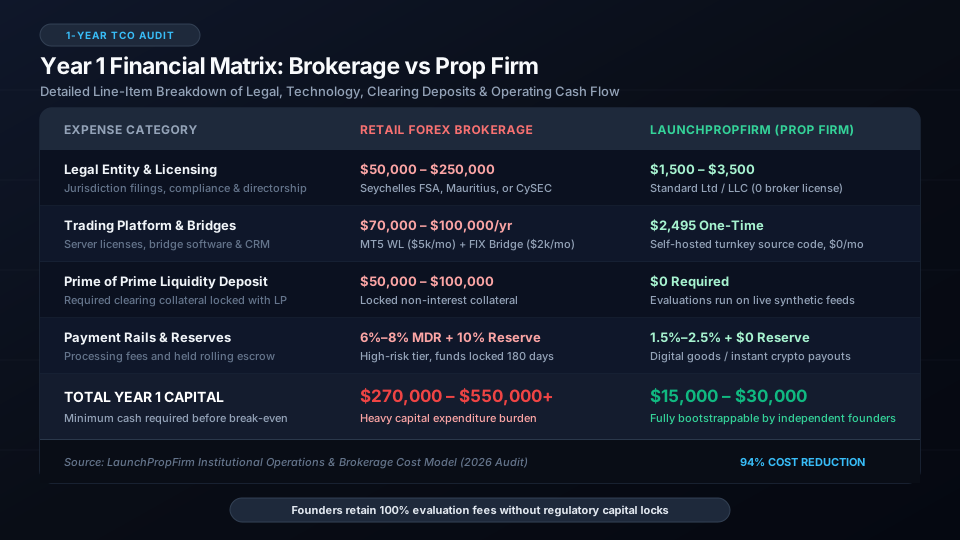
7. The Modern 2026 Alternative: Launching a Turnkey Prop Firm
Because the barriers to starting a brokerage have become so extreme, forward-thinking financial entrepreneurs in 2026 are pivoting to the proprietary trading firm model.
The funded trader model lets you operate a global trading platform while bypassing 90% of the financial and legal friction of a retail broker.
Zero Brokerage License Requirement
A modern proprietary trading firm does not accept deposits from retail investors or hold client money in margin trading accounts.
Traders pay an evaluation challenge fee to trade on simulated accounts configured with realistic market spreads and live data feeds.
Because evaluations constitute simulated performance assessments rather than deposit-taking brokerage activities, operators do not require a $100,000 financial brokerage license.
Founders establish standard corporate entities in business-friendly jurisdictions like the UK, UAE, or Delaware with zero regulatory delays.
100% Upfront Retained Revenue
In a retail brokerage, client deposits are liabilities that sit on your balance sheet until the trader trades or withdraws.
In a proprietary trading firm, challenge fees ($100 to $500 per challenge) represent immediate top-line revenue collected at checkout.
Statistically, 85% to 92% of evaluation attempts breach risk rules during Phase 1 or Phase 2, allowing the firm to retain the full entry fee.
To explore how operators project monthly profit and loss, study our breakdown of how much prop firm owners make.
Frictionless Digital Merchant Processing
Because prop firms sell educational challenge assessments rather than high-risk financial brokerage services, payment processing is clean and straightforward.
Operators qualify for standard digital goods merchant categorization, slashing processing fees down to 1.5% to 2.5% with 0% rolling reserves.
In addition, prop firm platforms seamlessly integrate direct cryptocurrency checkout (USDT, USDC, BTC), enabling instant worldwide settlements with zero bank clearance lag.
Traders can verify their rules and account mechanics directly using our free prop firm challenge rules guide.
8. Total Cost of Ownership: Brokerage vs Self-Hosted Prop Firm
The economic contrast between launching a traditional forex broker and launching an independent prop trading firm is striking.
With modern turnkey source code architecture, an entrepreneur can launch a fully functional trading firm for under $15,000 total capital.
| Cost & Operational Vector | Traditional Retail Brokerage | Turnkey Self-Hosted Prop Firm (LaunchPropFirm) | Founder Advantage |
|---|---|---|---|
| Licensing & Legal Setup | $50,000 to $130,000+ | $1,500 to $3,500 (Standard Ltd/LLC) | 95% Legal Savings |
| Trading Technology Platform | $70,000 to $100,000/yr (MT5 WL + Bridge) | $2,495 one-time (Permanent source code ownership) | $67,500+ Annual Savings |
| Monthly Software Subscriptions | $7,000 to $12,000 / month | $0.00 / month ($45/mo private Linux VPS) | Zero Ongoing Tech Rent |
| Clearing Liquidity Deposit | $50,000 to $100,000 blocked capital | $0 Required (Live synthetic market execution) | Zero Collateral Lock |
| Merchant Rolling Reserves | 10% locked for 180 days | 0% Locked (Immediate checkout payouts) | Total Cash Flow Freedom |
| Time to Market Launch | 6 to 12 months minimum | 10 to 14 days turnkey deployment | 10x Faster Go-To-Market |
| Minimum Launch Capital | $270,000 to $450,000+ | $15,000 to $25,000 total | 93% Lower Initial Capex |
Renting expensive SaaS platforms from white label vendors replicates the worst financial traps of legacy brokerages.
To calculate your exact cash savings across 1, 2, and 3 years, use our interactive SaaS vs self-hosted TCO calculator.
By acquiring sovereign source code through LaunchPropFirm prop firm source code, you own the entire platform forever with zero monthly user taxes.
Review our technical architecture benchmarks and engine specifications on our institutional platform specification sheet.
9. Step-by-Step Operator Roadmap: Launching in 14 Days
If your objective is to monetize retail trading flow, launching a proprietary trading firm allows you to reach profitability in weeks rather than years.
Here is the proven four-phase implementation roadmap deployed by successful operators:
Phase 1: Corporate Entity & Brand Foundation (Days 1–3)
Incorporate a standard limited liability entity in a reputable corporate jurisdiction such as the United Kingdom, Cyprus, or the United States.
Establish your domain, brand guidelines, and review our strategic guide on white label prop firm software to finalize your visual identity.
Phase 2: Deploying Turnkey Self-Hosted Infrastructure (Days 4–7)
Secure your turnkey platform via LaunchPropFirm for a single one-time payment of $2,495.
Deploy the pre-configured Docker containers onto your private Ubuntu server, connecting PostgreSQL databases and high-speed TradingView browser charting terminals.
Configure live multi-asset pricing feeds so your traders can analyze Forex, Indices, and Commodities with sub-50ms execution speed.
To review lean capital allocation strategies, consult our practical guide on how to start a prop firm with no money.
Phase 3: Risk Parameter Configuration & Merchant Rails (Days 8–10)
Set up your evaluation challenge parameters in the comprehensive admin back-office.
Define daily drawdown limits (typically 5%), maximum trailing or static drawdowns (typically 10%), and profit targets (8% Phase 1, 5% Phase 2).
Connect your payment gateway credentials for fiat debit/credit cards and activate crypto merchant rails via NowPayments or direct Web3 wallet webhooks.
You can accurately model your product pricing tiers using our prop firm pricing calculator.
Phase 4: Trader Acquisition & Affiliate Go-Live (Days 11–14)
Launch your built-in affiliate portal offering competitive 10% to 15% commissions to trading influencers, Telegram signal providers, and YouTube educators.
Automated affiliate tracking attributes referral sales instantly, generating trader acquisition without spending thousands on paid search ads.
To test your operational readiness and model challenge break-even targets, run our interactive prop firm readiness quiz.
Compare platform architecture models across the industry in our LaunchPropFirm competitor comparison directory.
10. Interactive Financial & Valuation Planning Tools
Building a profitable trading firm requires precise quantitative planning rather than guesswork.
Utilize our institutional calculator suite to model challenge sales, payout liability buffers, and balance sheet profitability:
- SaaS vs Self-Hosted TCO Calculator: Calculate how much capital you save over 36 months by owning self-hosted software instead of renting vendor SaaS.
- Prop Firm Pricing & Margin Calculator: Model gross revenues, pass rate assumptions, and net cash flow across $10k, $50k, and $100k account sizes.
- Master Prop Firm Business Plan Calculator: Simulate multi-month growth trajectories, trader acquisition costs, and reserve funding requirements.
- Drawdown & Loss Floor Simulator: Model static versus trailing high-water mark drawdown thresholds under extreme market volatility.
- Interactive Tools Directory: Access all 13+ free institutional calculators and financial planning models in one central hub.
Frequently Asked Questions About Starting a Forex Brokerage
How much money do you need to start a forex brokerage in 2026?
Starting a legally compliant retail forex brokerage in 2026 requires between $270,000 and $450,000 in Year 1 capital for an offshore jurisdiction like Seychelles or Mauritius.
This figure includes $50,000 in blocked regulatory capital, $90,000 in MT5 white label licenses, $75,000 in Prime of Prime clearing deposits, and $40,000 in payment processor rolling reserves.
Can you start a forex brokerage without a financial license?
Operating a retail forex brokerage without a financial license is illegal in virtually every global jurisdiction.
Unlicensed brokers face swift enforcement action, payment gateway account freezes, and international banking blacklisting because accepting customer deposits requires regulatory oversight.
What is the difference between a forex brokerage and a prop firm?
A forex brokerage accepts client cash deposits for live market margin trading and operates under strict financial services licensing.
A proprietary trading firm sells evaluation challenge accounts on simulated trading platforms, allowing founders to operate legally without a banking or brokerage license while keeping 100% of challenge fees.
How much does an MT5 white label cost to set up?
An MT5 white label typically costs $10,000 to $15,000 in upfront setup fees, combined with $5,000 to $8,500 in recurring monthly server maintenance fees.
In addition, MetaQuotes requires proof of an active financial license, commercial physical leases, and compliance infrastructure before approving any new white label broker.
Why do founders choose the prop firm model instead of starting a broker?
Founders choose the prop firm model because it reduces initial capital requirements by over 90%, slashing launch costs from $350,000 down to under $20,000.
Prop firm operators avoid brokerage licensing delays, bypass high-risk payment processor reserves, and collect upfront challenge revenue with zero clearing house counterparty risk.
How long does it take to launch a self-hosted prop firm?
A self-hosted prop firm using LaunchPropFirm's turn-key source code can be deployed and operational within 10 to 14 days.
In contrast, establishing an offshore retail forex brokerage typically requires 6 to 12 months for corporate formation, regulatory review, clearing agreements, and high-risk banking approvals.
Calculate SaaS Monthly Rent vs 1-Time Code Ownership
SaaS prop firm providers charge $2,500/mo plus 8% revenue share. Compare 12-month total expenses vs 100% source code ownership.

M.Haris
Founder & Platform ArchitectBuilding open prop trading software infrastructure for operators worldwide
I built LaunchPropFirm to give forex educators, trading communities, and fintech operators complete ownership of their platform with full source code and zero monthly SaaS rent. Every article on this blog is drawn from hands-on platform development, live MT5 risk bridge mechanics, and real operator economics.
All content, financial models, ROI estimates, and architecture guides on LaunchPropFirm are published strictly for educational and informational purposes. LaunchPropFirm provides institutional prop trading software and technology infrastructure; it does not operate as a broker, custodian, or registered investment advisor.
Evaluation challenges and funded trader accounts referenced in this guide operate in simulated demo trading environments using real-time market data feeds. Simulated trading results do not represent actual trading performance or financial advice.
Recommended Next Reads
Hand-picked operator guides to scale your prop trading platform.
What Is an Institutional Trading Platform? 2026 Guide
Discover what an institutional trading platform is in 2026. Explore FIX API bridges, L2 liquidity routing, risk engines, and prop trading architecture.
Wise Prop Firms: Payouts, Risks and Rails
Explore why direct Wise prop firms payouts trigger account freezes, how Rise compliance bridges protect funds, and why multi-rail payouts guarantee cash flow.
Skip the monthly fees
Own your prop firm platform outright. One time purchase.
Full source code. Live in 7 days. No revenue share. No monthly SaaS bill. See the exact platform before paying anything.
Demo login: haris / asdf1122. No signup needed