Prop Firm Rules for Traders: News, Hedging & EA Rules
Complete catalog of trading restrictions in prop firms: High-frequency trading (HFT), Martingale, weekend holding, news trading windows, and account IP bans.
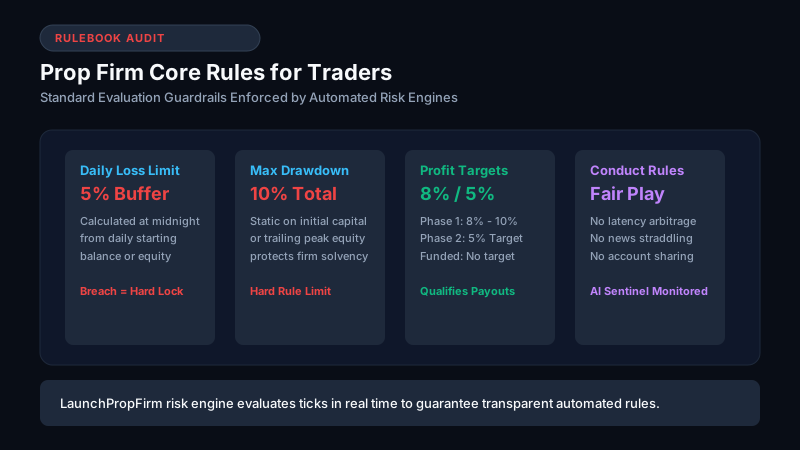
The Rules Are the Product
When I set up challenge rules for LaunchPropFirm, I realized the rules are not just risk management. They are the product itself. For instance, understanding prop firm copy trading rules is essential: while personal account mirroring is permitted, commercial pass syndicates are strictly banned.
Traders do not buy access to a trading account. They buy a set of rules they believe they can beat. If the rules feel fair, they buy. If they feel rigged, they do not.
Here is what every standard prop firm challenge includes and why each rule exists.
See a live prop firm platform with real challenge rules
The Two-Phase Structure
Most prop firm challenges use two evaluation phases before a trader receives a funded account.
Phase 1 is the initial evaluation. The trader needs to hit a profit target, typically 8% of the account balance, without violating loss limits. This phase has a time limit, usually 30 days.
Phase 2 is the consistency check. The trader needs to hit a lower profit target, typically 5%, under the same loss rules. The idea is to confirm that Phase 1 performance was not luck.
After passing both phases, the trader receives a funded account where they keep 80% of profits.
Profit Targets
The profit target is how much the trader needs to make to pass each phase. 8% in Phase 1 and 5% in Phase 2 is industry standard.
From a trader's perspective, 8% in 30 days requires consistent daily gains without overleveraging. An experienced trader targeting 0.5% per day can achieve this in 16 trading days.
From the operator's perspective, 8% is the filter. It eliminates traders who cannot produce consistent gains and separates them from traders who can profit but cannot manage risk.
Skip the monthly fees
Own your prop firm platform outright. One time purchase.
Full source code. Live in 7 days. No revenue share. No monthly SaaS bill. See the exact platform before paying anything.
Demo login: haris / asdf1122. No signup needed
Maximum Drawdown
Maximum drawdown is the total loss allowed from the starting balance. Once a trader loses 10% from their starting balance, the account closes automatically.
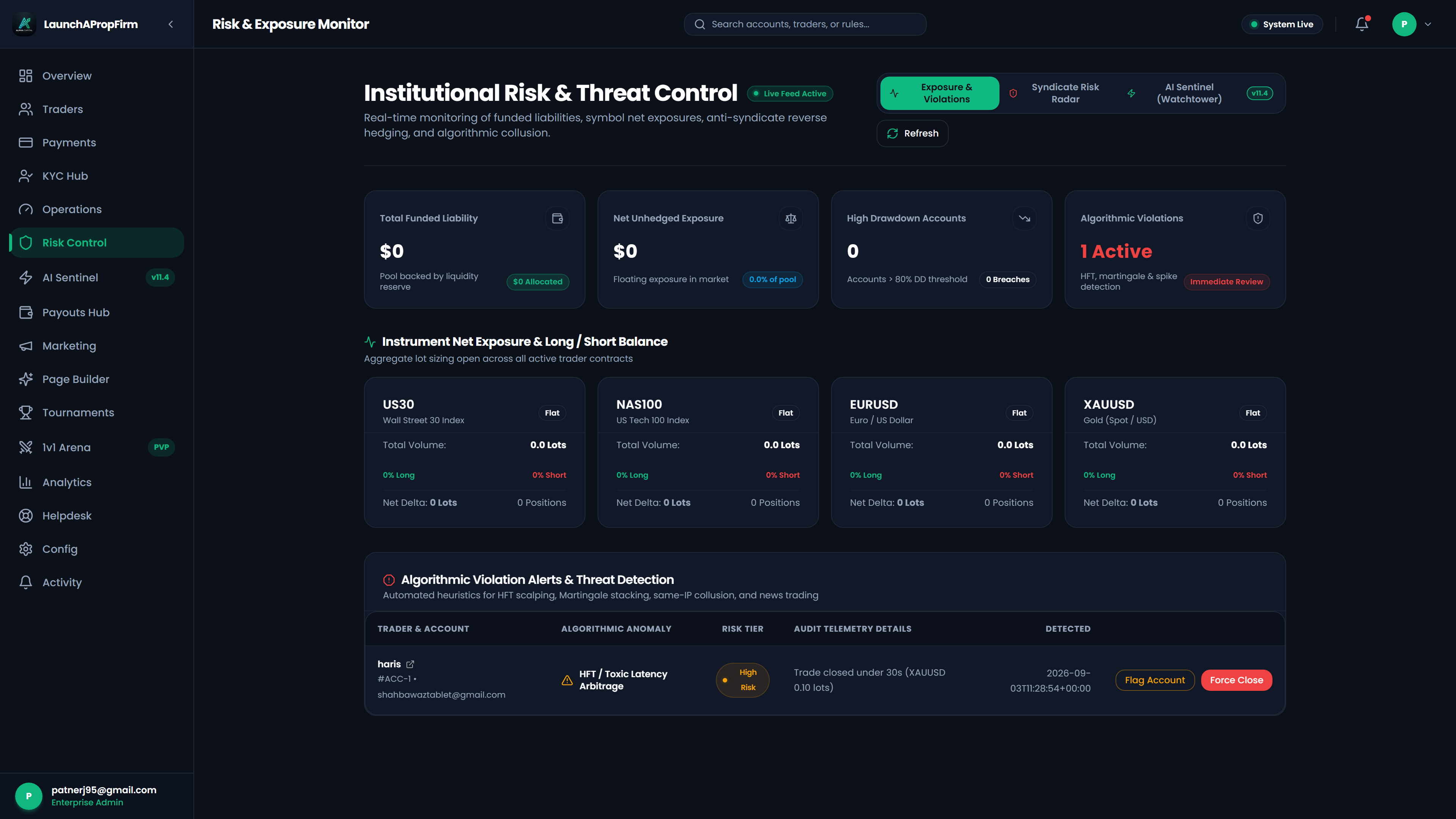
Centralized risk engine calculating floating equity, daily drawdown limits, and automated breach locks in real time.
This rule exists to filter traders who cannot manage their downside. A trader who loses 10% in a month is not a trader you want to fund.
Most firms use static drawdown, which measures from the starting balance always. Some use trailing drawdown, which measures from the highest balance reached. Trailing is harder for traders.
Daily Loss Limit
The daily loss limit caps how much a trader can lose in a single calendar day. Typically 5% of the starting balance.
Without a daily limit, a trader could lose their entire 10% drawdown buffer in one bad session and breach immediately. The daily limit forces session management, not just overall balance management.
From the trader's perspective, a 5% daily limit on a $25,000 account means a maximum daily loss of $1,250. That is a genuine daily stop that requires discipline.
Minimum Trading Days
Most challenges require a minimum number of trading days before a trader can complete the phase. Typically 5 days.
This rule prevents a trader from getting lucky on one massive trade and claiming a funded account. If you can open one trade, make 8% in a day, and pass Phase 1, you have not demonstrated anything about your trading. The minimum days rule requires the trader to actually trade across multiple sessions.
Time Limits
Phase 1 typically has a 30-day limit. Phase 2 has a 60-day limit.
Time limits add pressure and create urgency. From the operator's perspective, they also limit the window of payout exposure. a trader who cannot hit 8% in 30 days is unlikely to be a profitable funded trader.
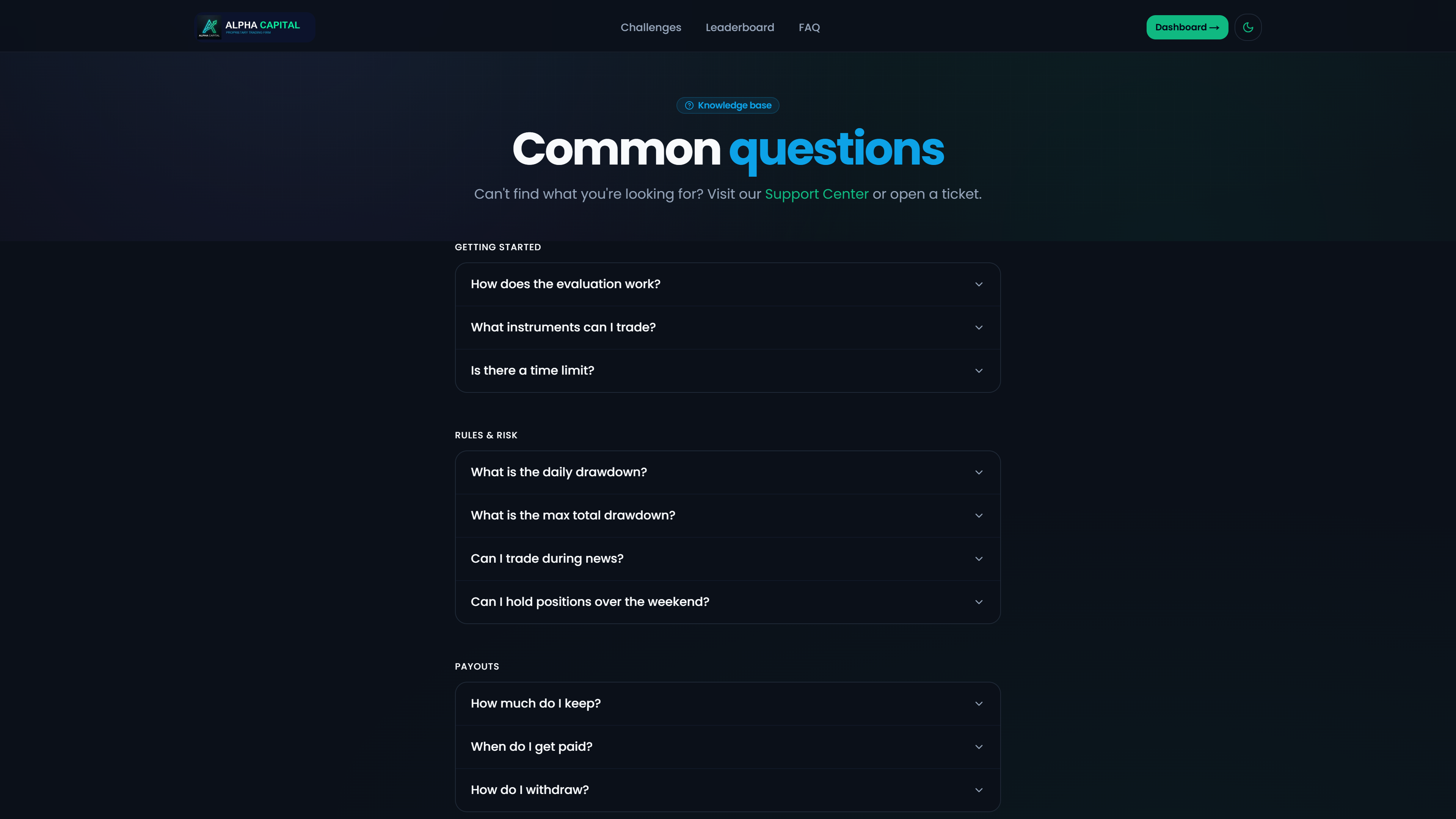
Some firms have removed time limits as a marketing feature. Unlimited time challenges are a selling point to traders who feel they need more runway.
What Traders Should Know Before Buying
Read the exact drawdown terms. Static vs trailing matters significantly. A trailing drawdown on a $25,000 account that you have grown to $30,000 means your stop is at $27,000, not $22,500.
Check the daily reset time. Some firms reset the daily loss limit at midnight server time. If the server is in a different timezone, your trading day may end earlier than you expect.
Ask about the consistency rule before buying if the firm has one. Some firms require that no single day accounts for more than 40% of total profits (use our free consistency rule calculator to test your daily ledger). This catches traders who make one big gain and do nothing else.
See how these rules look in a live platform
Operator Tip: Clear, specific challenge rules prevent disputes before they happen. Every rule should include a worked numeric example alongside the text definition. If you cannot explain the rule simply enough to write that example, the rule is too complex. Operators who invest one hour in writing clear rules avoid hundreds of support tickets.
Frequently Asked Questions
What challenge rules create the most trader disputes for operators?
Trailing drawdown calculation, the consistency rule, and inactivity policies are the three most common dispute sources. Trailing drawdown disputes happen when traders misunderstand how the floor adjusts as profits grow. Publishing a step-by-step numeric example for each rule prevents most of these disputes.
How should operators structure and publish challenge rules?
Publish rules on a dedicated page before any trader purchases a challenge. Include: profit target, max drawdown type and percentage, daily loss limit, minimum trading days, and any consistency or instrument restrictions. Link to this page from the checkout flow so traders confirm they have read it.
What is the consistency rule and should operators include it?
The consistency rule requires that no single trading day exceeds a defined percentage of total challenge profits, typically 30 to 50%. It prevents traders from gaming the evaluation with one large lucky trade and produces more reliably skilled funded traders. The tradeoff is added rule complexity for traders to understand.
How do operators enforce rules fairly across all traders?
Automated breach detection is the only fair method at scale. Rules enforced manually create room for inconsistency and accusations of favoritism. A platform that closes accounts automatically at the defined drawdown threshold applies the same standard to every trader, every time.
What happens when operators change rules after launch?
Rule changes apply to new challenge purchases only. Active challenges run under the rules in effect at the time of purchase. Retroactive rule changes are a reputation-damaging practice that has led to the downfall of multiple prop firms. Version-date your public rules so traders can reference what was in effect at their purchase date.
Model Your Firm's Monthly Cash Flow & Profit
Simulate challenger intake, pass rate payout reserves, and net operator margins with our free real-time economic calculator.
Prop Firm Monthly Profit Simulator
Simulate your challenge revenue, payout liability, and net monthly take-home profit.
$20,000
From upfront challenge fees-$2,800
~10 funded payouts budgeted$0 / month
Saves $3,000/mo vs SaaS$17,200/mo
Run-rate: $206,400/yr
M.Haris
Founder & Platform ArchitectBuilding open prop trading software infrastructure for operators worldwide
I built LaunchPropFirm to give forex educators, trading communities, and fintech operators complete ownership of their platform with full source code and zero monthly SaaS rent. Every article on this blog is drawn from hands-on platform development, live MT5 risk bridge mechanics, and real operator economics.
All content, financial models, ROI estimates, and architecture guides on LaunchPropFirm are published strictly for educational and informational purposes. LaunchPropFirm provides institutional prop trading software and technology infrastructure; it does not operate as a broker, custodian, or registered investment advisor.
Evaluation challenges and funded trader accounts referenced in this guide operate in simulated demo trading environments using real-time market data feeds. Simulated trading results do not represent actual trading performance or financial advice.
Recommended Next Reads
Hand-picked operator guides to scale your prop trading platform.
Wise Prop Firms: Payouts, Risks and Rails
Explore why direct Wise prop firms payouts trigger account freezes, how Rise compliance bridges protect funds, and why multi-rail payouts guarantee cash flow.
Prop Firm Capital: Requirements, Reserve Buffers and Risk Architecture
Unpack the financial reality of prop firm capital: synthetic exposure vs liquid reserves, challenge fee pool economics, A-Book STP hedging, and exact startup blueprints.
Skip the monthly fees
Own your prop firm platform outright. One time purchase.
Full source code. Live in 7 days. No revenue share. No monthly SaaS bill. See the exact platform before paying anything.
Demo login: haris / asdf1122. No signup needed