Profit Loss Calculator: Forex PnL Formula & Guide 2026
Calculate forex trade profits and losses accurately in 2026. Master long and short PnL formulas, pip values, percentage returns, and risk math.
Why do over 90% of retail forex traders fail to pass prop firm evaluations during their first month?
Most traders fail because they enter trades without knowing their exact dollar risk or profit target before execution.
Relying on rough estimates leads to overleveraged positions and rapid account blowouts.
A disciplined trader treats every order as a mathematical transaction governed by risk parameters and statistical expectancy.
Understanding how a professional profit loss calculator functions allows you to size trades correctly and defend daily loss limits.
1. What Is a Profit Loss Calculator in Trading?
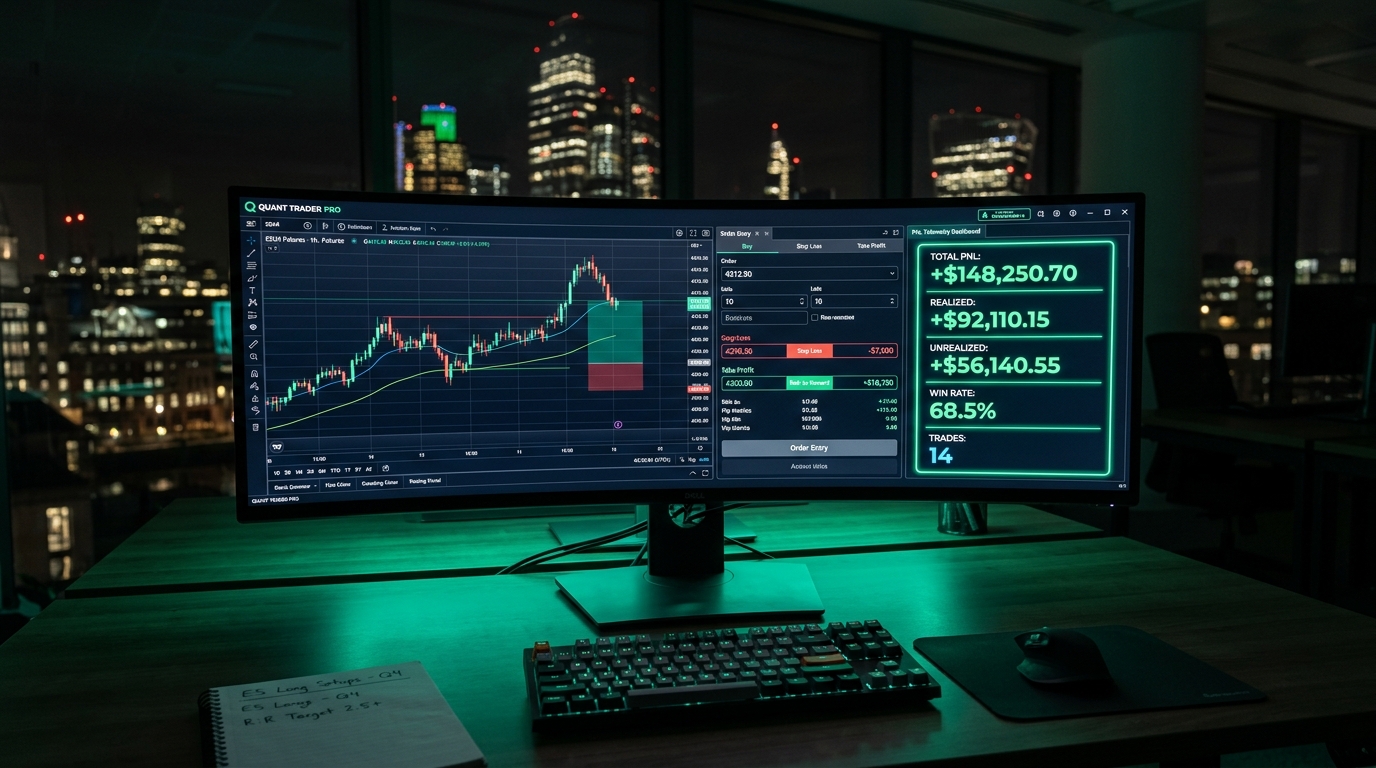
A profit loss calculator is an analytical tool used by currency and CFD traders to determine trade outcomes before order fill.
It translates price movement measured in points and pips into concrete dollar gains or losses based on contract size and volume.
Instead of guessing equity exposure, you calculate the exact dollar return for any target exit price in advance.
In proprietary trading, this calculation forms the bedrock of capital preservation and drawdown compliance.
When managing strict challenge rules like a 5% daily loss limit, precise calculations prevent accidental rule breaches.
You can cross-reference your position sizing using our free lot size calculator alongside our prop firm drawdown calculator.
Core Components of Trade PnL
Every trade calculation requires five core data inputs:
- Direction: Long (buy order targeting price gains) or Short (sell order targeting price declines).
- Entry Price: The exact fill rate at which your position opens.
- Exit Price: Your targeted take-profit level or defensive stop-loss execution quote.
- Position Size: The volume traded in standard lots, mini lots, or micro lots.
- Contract Multiplier: The underlying unit count that standardizes pip values into account currency.
2. The Mathematical Profit Calculator Formula
To calculate trade profit or loss manually, apply directional pricing equations that account for market bias.
A long order generates profit when the exit rate exceeds the entry price.
Conversely, a short order generates profit when the exit price drops below the entry quote.
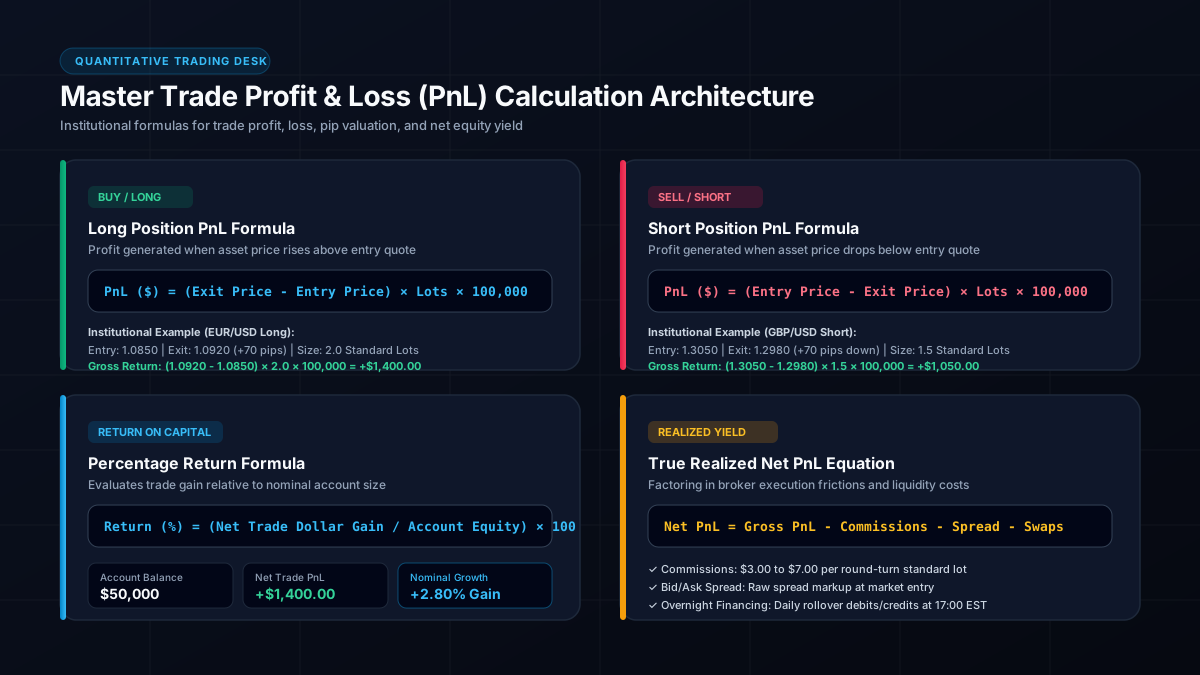
The Long Position PnL Formula
For long (buy) orders, profit and loss is calculated with the following equation:
PnL ($) = (Exit Price - Entry Price) × Position Size (Lots) × Contract Multiplier
Consider a trader opening a 2.0 standard lot long position on EUR/USD:
- Entry Price: 1.0850 | Exit Price: 1.0920 (+70 pips)
- Contract Size: 100,000 units per standard lot
- Gross Trade PnL: (1.0920 - 1.0850) × 2.0 × 100,000 = +$1,400.00 Profit
If the market drops to 1.0810, hitting a 40-pip stop loss:
- Gross Trade PnL: (1.0810 - 1.0850) × 2.0 × 100,000 = -$800.00 Loss
The Short Position PnL Formula
For short (sell) orders, the price direction is inverted:
PnL ($) = (Entry Price - Exit Price) × Position Size (Lots) × Contract Multiplier
Consider a trader taking a 1.5 standard lot short position on GBP/USD:
- Entry Price: 1.3050 | Exit Price: 1.2980 (+70 pips decline)
- Contract Size: 100,000 units per standard lot
- Gross Trade PnL: (1.3050 - 1.2980) × 1.5 × 100,000 = +$1,050.00 Profit
If the exchange rate rallies upward to 1.3100, triggering a 50-pip stop loss:
- Gross Trade PnL: (1.3050 - 1.3100) × 1.5 × 100,000 = -$750.00 Loss
3. How to Calculate Percentage Profit in Trading
While dollar profit shows nominal gains, percentage profit evaluates capital efficiency and risk performance.
Evaluating percentage yield allows you to compare performance across challenge tiers from $10k to $200k.
Professional prop desks evaluate consistency through percentage return rather than arbitrary cash values.
The Percentage Profit Calculator Formula
The formula for calculating percentage return on account equity is:
Percentage Return (%) = (Net Trade Dollar Profit / Starting Account Balance) × 100
Here is how this applies across different prop firm evaluation tiers:
- A $1,400 profit on a $25,000 account represents a +5.60% account gain.
- A $1,400 profit on a $50,000 account represents a +2.80% account gain.
- A $1,400 profit on a $100,000 account represents a +1.40% account gain.
Tracking percentage returns ensures compliance with prop firm consistency rules and daily drawdown caps.
Explore our prop firm consistency calculator to verify that a single winning day does not exceed your target profit cap.
4. Multi-Asset Pip Value and Contract Size Differences
A common trap for emerging traders is assuming that one pip equals the exact same dollar amount across all assets.
Because contract specifications vary, a 20-point move on Gold produces different dollar swings than 20 pips on EUR/USD.
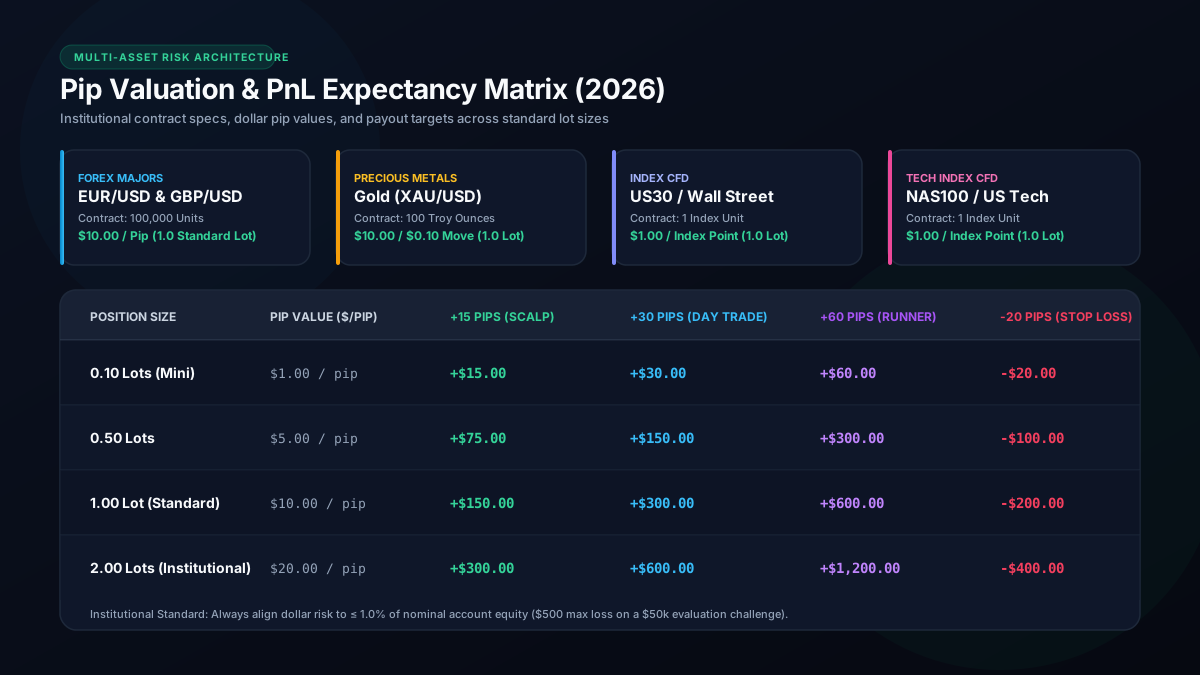
Forex Currency Majors (EUR/USD, GBP/USD, AUD/USD)
On forex pairs where the US Dollar is the quote currency, pip values remain fixed regardless of spot price:
- 1.00 Standard Lot (100,000 units) = $10.00 per pip (0.0001 price move)
- 0.10 Mini Lot (10,000 units) = $1.00 per pip
- 0.01 Micro Lot (1,000 units) = $0.10 per pip
Review our detailed forex lot size chart to master position sizing mechanics across exotic and minor currency pairs.
Gold (XAU/USD) Commodity CFDs
Gold is quoted in US Dollars per troy ounce, with standard contracts representing 100 ounces:
- A price change of $0.01 (one cent) equals 1 pip, yielding $1.00 per standard lot.
- A price change of $0.10 (one point) yields $10.00 per standard lot.
- A price change of $1.00 (one full dollar move) yields $100.00 per standard lot.
Align your execution with institutional liquidity windows by reviewing our guide to gold trading hours.
Cash Indices (US30, NAS100, US500)
Index CFDs mirror benchmark equity baskets and are priced in index points:
- 1.00 Lot of US30 (Wall Street 30) = $1.00 per full point.
- 1.00 Lot of NAS100 (US Tech 100) = $1.00 per full point.
- A 100-point move on NAS100 with a 2.0 lot position yields +$200.00 in trade PnL.
Because index instruments experience large daily ranges, position sizing must be scaled downward to protect account equity.
You can simulate multi-month compounding on funded accounts using our free compounding simulator.
5. Gross PnL vs Realized Net PnL: Operational Friction
Beginner traders often calculate theoretical profit based purely on entry and exit price differences.
When they close positions, account balances show a lower payout than initial expectations.
This discrepancy occurs because live market execution incurs transaction costs that reduce gross trading profits.
The Realized Net PnL Equation
To calculate your actual cash gain, deduct execution frictions:
Realized Net PnL = Gross Trade Profit - Round-Turn Commission - Bid/Ask Spread - Overnight Swaps
Operational costs impact your bottom line through three distinct mechanisms:
- Commissions: Raw accounts charge $3.00 to $7.00 per round-turn standard lot.
- Bid/Ask Spread: The buy and sell quote differential creates an immediate paper loss upon order fill.
- Overnight Swaps: Positions held past the 17:00 EST daily rollover incur interest debits or credits.
Tracking these deductions inside a structured free trade journal helps you evaluate true expectancy. When converting closed trading gains into funded account withdrawals, calculate your take-home sum with our prop firm payout calculator to account for profit splits and fee refunds.
6. How Prop Firm Operators Use Automated PnL Sentinels
Behind every retail platform lies an institutional risk engine monitoring live PnL across thousands of trader accounts.
Prop firm operators cannot review trade tickets manually or calculate drawdown violations on spreadsheets.
Automated server-side sentinels stream live price feeds and recompute equity down to the millisecond.
If a trader breaches a 5% daily loss limit, the sentinel liquidates open positions and freezes terminal access.
These automated parameters ensure disciplined risk managers succeed while reckless gambles are neutralized immediately.
For entrepreneurs launching a prop firm, LaunchPropFirm delivers turnkey self-hosted infrastructure with pre-integrated risk engines.
Rather than paying $3,000/mo in recurring SaaS fees, founders receive 100% source code ownership for $2,495 one-time.
Explore our white label prop firm software architecture and test live admin dashboards at demo.launchapropfirm.com.
7. Step-by-Step Trade PnL Calculation Checklist
Before placing an order in your trading terminal, execute this 5-step risk verification protocol:
- Measure Invalidation Distance: Determine the exact pip distance between entry and stop loss (e.g. 25 pips on EUR/USD).
- Determine Dollar Risk Limit: Cap maximum trade loss at 1.0% of balance ($500 on a $50,000 evaluation account).
- Calculate Position Size: Divide dollar risk by pip distance and pip value ($500 / [25 pips × $10/pip] = 2.0 Lots).
- Model Target Profit: A 50-pip target yields +$1,000 gain, delivering a 1:2 Risk-to-Reward ratio.
- Deduct Commission Frictions: Subtract round-turn commissions ($14 on 2 lots) to verify net realized payout.
Following this structured process removes emotional impulse and ensures that every trade executed moves you closer to funded trader certification.
You can explore our complete directory of free trader resources inside our trading tools hub.
Frequently Asked Questions
What is the formula for calculating profit and loss in forex?
For a buy (long) position, the formula is: PnL = (Exit Price - Entry Price) × Lot Size × 100,000.
For a sell (short) position, the formula is: PnL = (Entry Price - Exit Price) × Lot Size × 100,000.
How much is 1 pip worth in US Dollars?
On major pairs like EUR/USD or GBP/USD, 1 pip equals $10.00 on a standard lot (1.00), $1.00 on a mini lot (0.10), and $0.10 on a micro lot (0.01).
How do I calculate profit percentage on a trading account?
Divide net dollar profit by starting balance and multiply by 100: (Net Profit / Balance) × 100. Making $1,500 on a $50k account equals a 3.00% profit.
What is the difference between gross profit and net profit in trading?
Gross profit is the price difference multiplied by position volume. Net profit is your realized cash return after deducting broker commissions, spread markup, and overnight swap fees.
How does Gold (XAU/USD) pip calculation differ from Forex?
On 100-ounce Gold contracts, a $0.01 move equals 1 pip ($1.00/lot), while a $1.00 move equals $100.00. Gold produces larger dollar swings than standard forex pairs.
Why do prop firms enforce daily loss limits alongside overall drawdown?
Daily loss limits prevent emotional revenge trading during losing sessions. They enforce intraday discipline by capping maximum daily equity decline to 4% or 5%.
Evaluate Your Prop Firm Readiness Score (0-100)
Answer 5 quick operational questions about your acquisition channels, runway, and engine tech to get a personalized launch roadmap.

M.Haris
Founder & Platform ArchitectBuilding open prop trading software infrastructure for operators worldwide
I built LaunchPropFirm to give forex educators, trading communities, and fintech operators complete ownership of their platform with full source code and zero monthly SaaS rent. Every article on this blog is drawn from hands-on platform development, live MT5 risk bridge mechanics, and real operator economics.
All content, financial models, ROI estimates, and architecture guides on LaunchPropFirm are published strictly for educational and informational purposes. LaunchPropFirm provides institutional prop trading software and technology infrastructure; it does not operate as a broker, custodian, or registered investment advisor.
Evaluation challenges and funded trader accounts referenced in this guide operate in simulated demo trading environments using real-time market data feeds. Simulated trading results do not represent actual trading performance or financial advice.
Recommended Next Reads
Hand-picked operator guides to scale your prop trading platform.
Breaker Block Trading Strategy: How to Trade Block Failures
Master the breaker block trading strategy. Learn how failed order blocks create high-probability liquidity retests with exact entry, stop loss, and RR rules.
Advantages of Forex Trading: 2026 Benefits & Risk Guide
Explore the core advantages of forex trading in 2026. Master 24/5 liquidity, leverage mechanics, major currency pairs, and the risk reality.
Community Monetization & Platform Ownership
Run a Trading Discord, Telegram, or Signal Group? Launch Your Own Prop Firm in 7 Days.
Stop sending your community to third-party prop firms. Own our complete white-label prop firm platform with all automated risk engines, live TradingView charts, MT5 bridge, and paid tournament engine from just $995 down under 50% milestone escrow. Zero monthly SaaS fees.