Professional Forex Trading Framework Guidelines (2026)
Master professional forex trading framework guidelines in 2026. Explore institutional risk models, 1% rules, liquidity sweeps, and consistency frameworks.
Operating without a systematic forex trading framework is why over 90% of retail participants forfeit capital within 90 days. For founders launching white label prop firm software, enforcing clear risk rules protects firm balance sheets days.
Professional currency desks treat trading as an engineered probability process rather than discretionary chart guessing.
In 2026, prop firm evaluation challenges demand strict algorithmic adherence to daily drawdowns, consistency metrics, and position sizing.
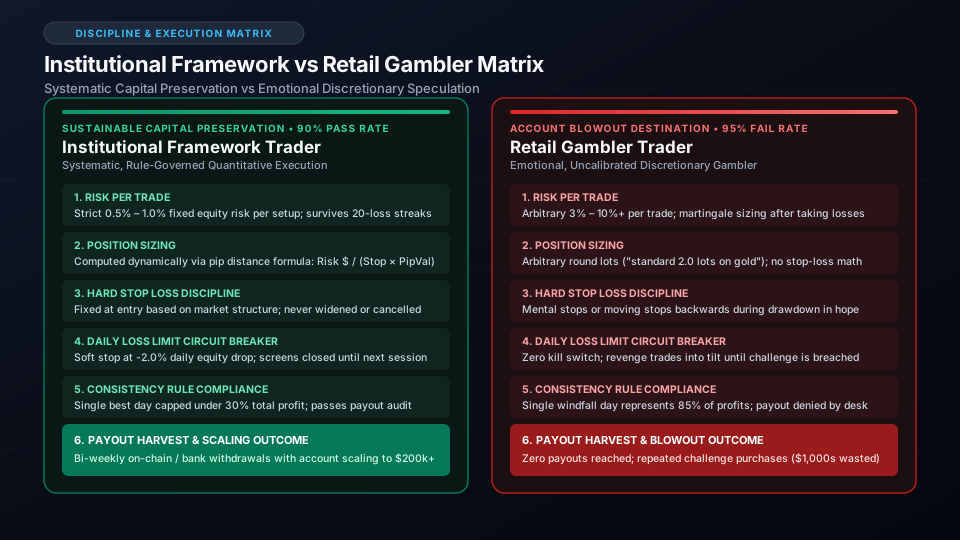
Following structured professional forex trading framework guidelines separates sustainable career traders from emotional market gamblers.

1. Quick Comparison Matrix: 5-Pillar Institutional Framework Overview
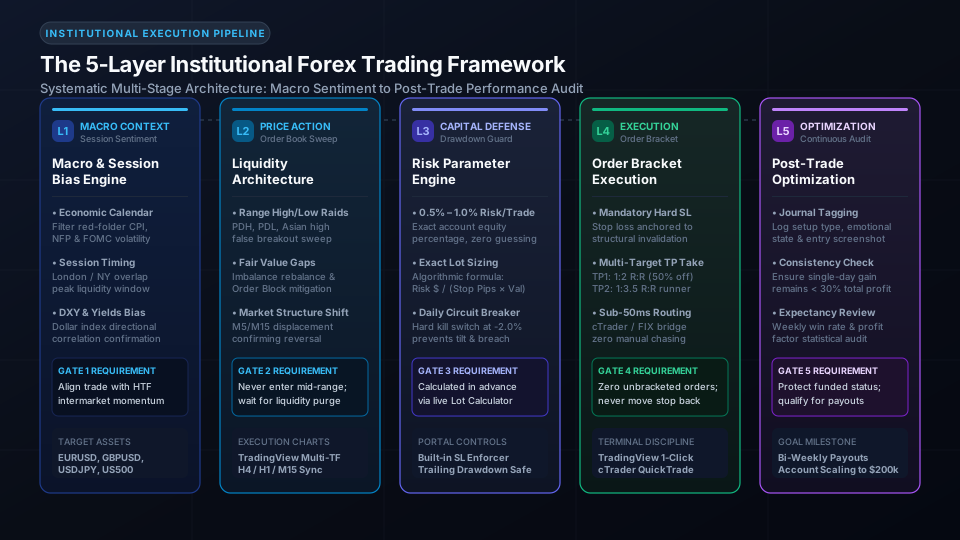
Professional trading desks organize every session around a 5-layer execution stack designed to filter low-probability market noise.
Before risking equity, institutional traders verify alignment across macroeconomic context, price structure, risk parameters, order execution, and post-trade performance analytics. For deeper technical context, build repeatable execution plans using proven forex trading strategies.
The following comparison matrix details the operational focus, quantitative benchmark, and tooling required across each stage of a professional forex trading framework.
Evaluating these parameters before every session ensures complete alignment with institutional capital preservation standards.
| Framework Layer | Operational Mandate | Target Metric | Recommended Tooling |
|---|---|---|---|
| 1. Macro Bias | Filter high-impact calendar volatility & assess session directional momentum | Zero trade entries 5 minutes before and after red-folder CPI / NFP releases | Multi-Timeframe Charts & Heatmaps |
| 2. Liquidity | Identify previous session liquidity sweeps and Fair Value Gap imbalances | Enter exclusively after structural displacement and liquidity sweeps | TradingView & cTrader DOM |
| 3. Risk Engine | Calculate exact position sizing based on pip distance to invalidation | Strictly 0.5% to 1.0% equity risk per trade; hard daily limit of -2.0% | Lot Size Calculator |
| 4. Order Bracket | Deploy non-negotiable hard stop-loss and multi-target profit bracket orders | Minimum 1:2 initial risk-to-reward ratio with trailing runner target | 1-Click Order Tickets |
| 5. Post-Trade Audit | Record setup metrics in trade journal and audit daily profit distribution | Single largest day profit must remain under 30% of total challenge gain | Consistency Calculator |
Adhering to this structured framework guarantees that traders never commit capital on impulse or emotion.
Each layer acts as an institutional security firewall, ensuring that poor setups are filtered before an order ticket touches the broker matching engine.
2. Layer 1: Macro Sentiment & Session Liquidity Bias
The first layer of any institutional forex trading framework establishes market context before opening a single chart.
Trading currency pairs without understanding macroeconomic sentiment or intermarket flows is equivalent to navigating blind through volatile markets.
Institutional desks begin their morning review by scanning economic calendars for red-folder catalysts such as CPI, Non-Farm Payrolls, and interest rate decisions.
A core tenet of professional forex trading guidelines is enforcing a mandatory 5-minute pre-news and post-news execution blackout to avoid wide spreads and slippage.
Forex liquidity concentrates heavily during the London and New York session overlap between 13:00 and 17:00 UTC.
As detailed in our guide on the best time to trade forex, confining execution to these peak liquidity hours provides tight spreads and clean directional trending moves.
3. Layer 2: Liquidity Architecture & Order Book Engineering
Once session bias is established, professional traders analyze liquidity distribution across the chart.
Large institutions cannot enter positions with a single mouse click without shifting price against themselves, so smart money algorithms engineer liquidity by sweeping retail stop losses.
The most reliable liquidity pools accumulate directly above the Previous Day High (PDH) and below the Previous Day Low (PDL).
Professional guidelines dictate waiting for price to sweep these extreme levels during the London or New York open before entering on clear rejection candles.
Following a liquidity sweep, institutional algorithms push price rapidly in the opposite direction, creating market structure displacement.
This displacement leaves three-candle Fair Value Gaps (FVGs) where professional traders place limit orders, as covered in our guide on how to learn how to day trade and when does a bearish market become bullish in forex.
4. Layer 3: Quantitative Risk Engine & Position Sizing
Implementing a structured forex risk management framework is the mathematical cornerstone of institutional longevity in financial trading.
An edge in technical analysis is completely worthless if a trader risks 5% of their account on a single idea and experiences a standard four-trade losing streak.
Institutional trading desks enforce a strict capital preservation invariant: never risk more than 0.5% to 1.0% of account equity on any individual trade setup.
For prop firm challenges with rigid 8% to 10% maximum drawdown limits, capping risk at 0.5% per trade is the mathematically optimal path to passing evaluations.
Quantitative Position Sizing Formula:
Lot Size = (Account Balance × Risk Percentage) ÷ (Stop Loss Pips × Pip Value per Standard Lot)
*Example:* On a 100,000 USD account risking 1.0% (1,000 USD) with a 20-pip stop on EURUSD (10 USD/pip): Lot Size = 1,000 ÷ (20 × 10) = 5.0 Standard Lots.
Computing this formula manually during fast market conditions frequently leads to costly execution mistakes.
To guarantee mathematical precision, utilize dedicated forex risk management tools, cross-reference our institutional forex lot size chart, and size orders with our Lot Size Calculator.
Beyond individual trade sizing, professional frameworks enforce a daily circuit breaker: when cumulative daily losses reach -2.0%, the trading terminal is locked until the next market day.
Monitor your drawdown cutoff windows with the Reset Clock Tracker and test loss streaks using our free Drawdown Calculator.
5. Layer 4: Order Bracket Execution & Invalidation Discipline
The fourth layer of the framework governs the physical execution of orders inside the trading terminal.
Even with flawless macro bias and exact position sizing, poor execution discipline can ruin trade expectancy through premature exits or delayed entries.
Entering a forex trade without a predefined hard stop loss placed directly in the broker order book is an immediate disqualifier on professional desks.
A professional hard stop loss is anchored to structural market invalidation, marking where the trade thesis is proven false, and must never be widened.
Institutional execution models utilize split profit targets to de-risk trades while allowing winning positions to capture extended trends.
At Take Profit 1 (1:2 R:R), traders close 50% of the position and move the stop loss to breakeven, trailing the remaining 50% runner toward 1:3.5 or 1:4 R:R.
Modern web terminals offer 1-click execution brackets that automatically attach stop losses and take-profit targets upon order transmission.
To compare execution latency, charting depth, and prop firm compatibility across MT5, cTrader, and TradingView, read our guide on the best forex trading platform for beginners.
6. Layer 5: Post-Trade Analytics & Consistency Rules
The final layer of a professional trading framework operates after the trading terminal is closed.
Amateur traders celebrate green days and bury red days, whereas institutional operators treat every trade as a data point in a statistical optimization system.
Every executed trade must be documented in a quantitative trade journal with setup tags, timestamps, screenshot markups, and realized R-multiples.
To build a disciplined data-driven record of your trading performance, explore our recommendations for the top free trade journal tools.
Most modern prop firms enforce strict consistency rules requiring that no single trading day accounts for more than 20% to 30% of total accumulated profits.
Before submitting withdrawal requests, calculate your distribution in advance using our Consistency Calculator, and model earnings with our Prop Firm vs Personal Account Calculator to master why discipline is key in our analysis of is day trading hard.
7. B2B Perspective: How Prop Firm Desks Monitor Frameworks
Understanding how a prop firm trading framework operates behind the scenes provides traders with critical insight into institutional standards.
Prop firm operators employ advanced automated risk sentinels and real-time execution bridges to analyze order flow for latency arbitrage and unhedged exposure.
Server-side risk sentinels monitor equity drawdowns in real time, calculating balance and equity high-water marks down to the millisecond.
If an unbracketed position causes an account to breach its daily loss limit during overnight rollover, the sentinel liquidates open positions automatically.
For operators launching a prop firm, LaunchPropFirm delivers turnkey infrastructure with automated challenge lifecycles, risk monitors, and terminal integrations.
Explore our prop firm source code suite to deploy your firm, and use our free trading firm tools to optimize your architecture with zero recurring SaaS fees.
Frequently Asked Questions
What is a professional forex trading framework?
A professional forex trading framework is an institutional rulebook governing market analysis, risk parameters, order execution, and performance analytics.
It eliminates emotional guesswork by requiring systematic technical and quantitative criteria before committing capital to live markets.
Why is risk per trade strictly capped at 1% or lower?
Capping risk per trade at 0.5% to 1.0% ensures that unavoidable losing streaks do not cause devastating drawdowns.
A 10-trade losing streak at 1% risk results in under 10% drawdown, whereas risking 5% destroys over 40% of equity.
How does the 30% prop firm consistency rule work?
The 30% consistency rule requires that a single trading day must not exceed 30% of total evaluation profits.
Prop firms enforce this rule to reward repeatable, disciplined execution over lucky high-leverage gambles.
What trading platforms support institutional visual order brackets?
TradingView, cTrader, and MetaTrader 5 support visual order brackets and 1-click execution tickets.
TradingView and cTrader provide the cleanest interfaces for dragging stop-loss and take-profit brackets directly on charts.
How should a forex trading framework handle high-impact news events?
A disciplined framework enforces a mandatory 5-minute execution blackout before and after red-folder economic releases.
Spreads widen significantly during news events, causing severe execution slippage that bypasses stop-loss orders.
Can following a mechanical framework turn an unprofitable trader into a funded trader?
Yes, because most traders fail due to emotional errors like revenge trading and moving stop losses.
A mechanical framework removes emotional impulse, protects drawdowns, and allows statistical expectancy to compound over time.
Evaluate Your Prop Firm Readiness Score (0-100)
Answer 5 quick operational questions about your acquisition channels, runway, and engine tech to get a personalized launch roadmap.

M.Haris
Founder & Platform ArchitectBuilding open prop trading software infrastructure for operators worldwide
I built LaunchPropFirm to give forex educators, trading communities, and fintech operators complete ownership of their platform with full source code and zero monthly SaaS rent. Every article on this blog is drawn from hands-on platform development, live MT5 risk bridge mechanics, and real operator economics.
All content, financial models, ROI estimates, and architecture guides on LaunchPropFirm are published strictly for educational and informational purposes. LaunchPropFirm provides institutional prop trading software and technology infrastructure; it does not operate as a broker, custodian, or registered investment advisor.
Evaluation challenges and funded trader accounts referenced in this guide operate in simulated demo trading environments using real-time market data feeds. Simulated trading results do not represent actual trading performance or financial advice.
Recommended Next Reads
Hand-picked operator guides to scale your prop trading platform.
Breaker Block Trading Strategy: How to Trade Block Failures
Master the breaker block trading strategy. Learn how failed order blocks create high-probability liquidity retests with exact entry, stop loss, and RR rules.
Advantages of Forex Trading: 2026 Benefits & Risk Guide
Explore the core advantages of forex trading in 2026. Master 24/5 liquidity, leverage mechanics, major currency pairs, and the risk reality.
Community Monetization & Platform Ownership
Run a Trading Discord, Telegram, or Signal Group? Launch Your Own Prop Firm in 7 Days.
Stop sending your community to third-party prop firms. Own our complete white-label prop firm platform with all automated risk engines, live TradingView charts, MT5 bridge, and paid tournament engine from just $995 down under 50% milestone escrow. Zero monthly SaaS fees.